

GOD (Generator of Diversity):

Humanity’s Evolving Understanding of Nature
The Origin of Religion: A Reflection on Humanity’s Search for Meaning
Religion is a mirror of the human mind—a socio-cultural phenomenon born from our need to make sense of existence. Since ancient times, humans have gazed at the world, from dense forests to open savannas, and imagined forces beyond the senses. Central to this imagining is the concept of a “Great Being,” a creator whose essence shifts across cultures and epochs. While many traditions hinge on creationism, others, like Buddhism and Jainism, pursue understanding through empirical inquiry, standing apart as intellectual anomalies in the religious landscape.
Religion, as we know it, is both a system of beliefs and a tapestry of rituals, sacred symbols, and mythologies, often deeply tied to geography and culture. What one considers sacred is largely influenced by the accident of birth: a child born in India might grow up with the Bhagavad Gita, while one in the Americas might be taught the Bible, or someone in modern China is presented with the Tao Te Ching. Even in today’s digital age, where global information is readily accessible, many still hold fast to inherited beliefs, shaped by early impressions that often endure into adulthood.
Historically, religion served as a repository for humanity’s best attempts to understand the cosmos and our place within it. Ancient peoples observed nature’s rhythms—stars, seasons, life, and death—and constructed narratives to explain these phenomena. Over time, these stories evolved into doctrines, and myth was often mistaken for literal truth. As anthropologist Gerald Massey noted, mythology itself never lied; it was misinterpreted as history, leading to the rigid doctrines that bind many today.
At its core, religion is the projection of human thought. The gods of ancient texts—be they Yahweh, Allah, Vishnu, or Ra—reflect humanity’s own image, our hopes and fears writ large. This anthropomorphic tendency explains why divine figures often embody human qualities: wrath, love, justice, and mercy. Yet this process of deification often obscures the profound insight that the divine is not an external entity but a reflection of the human psyche.
God as Energy: A Modern Lens
The first law of thermodynamics teaches us that energy is eternal, neither created nor destroyed. If we redefine God as energy, the divide between science and spirituality diminishes. Ancient myths, grounded in empirical observations, would no longer seem antagonistic to modern science but rather poetic expressions of universal truths. For example, the sun—a common symbol of divinity—can be seen as a literal creator of life, driving the chemical processes that sustain existence.
Similarly, modern cosmology reveals a universe shaped by forces of creation and destruction, echoing ancient narratives. Concepts like quantum entanglement and the interconnected nature of particles resonate with the timeless view of divinity as an omnipresent force that binds all things. This redefinition brings ancient wisdom and modern science into harmony.
The Feminine and Masculine in Divinity
Throughout history, humanity’s concept of divinity has oscillated between masculine and feminine archetypes, reflecting the sociocultural dynamics of the time. In matriarchal eras, the divine mother was revered as the source of life. With the rise of patriarchal societies, God was reimagined as an all-powerful father, often to the exclusion of feminine attributes. This shift reduced the sacred role of women, confining them to subordinate positions in both religious and social spheres.
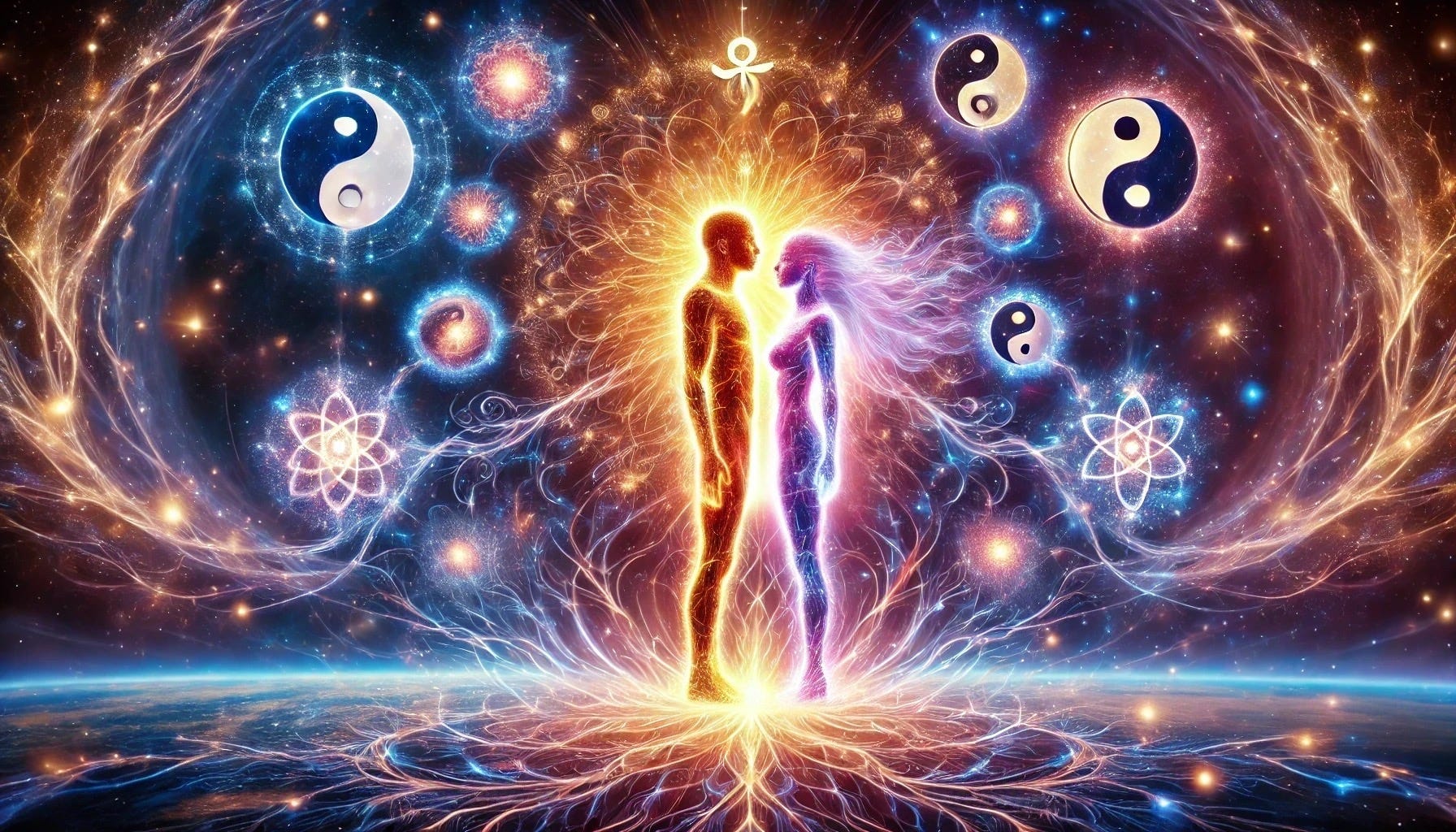
Many ancient African traditions, as well as some archaic spiritual systems in Eurasia, preserved a balance. The Egyptian trinity—Ausar (Osiris), Aset (Isis), and Heru (Horus)—symbolized harmony between masculine and feminine forces, a reconciliation of dualities that modern monotheistic religions often lack. The genderless nature of divinity, as seen in ancient Egypt’s concept of Neter, reminds us that “God”—nature writ large—transcends human binaries.
In ancient India, the interplay of masculine and feminine divinity is most evident in the concept of Shakti, the primordial feminine energy that empowers male deities. Without Shakti, even gods like Shiva are considered inert. This balance is epitomized in the Ardhanarishvara form of Shiva, a deity depicted as half-male and half-female, embodying the inseparable union of masculine and feminine principles. The Trimurti—Brahma, Vishnu, and Shiva—often worked in tandem with their feminine consorts Saraswati, Lakshmi, and Parvati, highlighting a divine partnership essential for cosmic balance.
In ancient Greece, the pantheon of gods included powerful feminine archetypes alongside their masculine counterparts. Athena, the goddess of wisdom and war, and Demeter, the goddess of agriculture and fertility, represented domains as significant as those governed by male gods like Zeus or Apollo. The duality of male and female forces was not only acknowledged but celebrated, with goddesses playing central roles in myths of creation, sustenance, and even destruction.
Similarly, in ancient Europe, pre-Christian Celtic spirituality revered both masculine and feminine deities. The Morrigan, a powerful goddess associated with sovereignty, war, and fate, coexisted with gods like Dagda, the “good god” of wisdom and abundance. The reverence for feminine energy was evident in the worship of goddesses tied to nature, fertility, and the cycles of life, a connection later diminished with the advent of Christianity’s patriarchal structure.
These examples demonstrate that the balance of masculine and feminine divinity was once integral to spiritual systems across continents. Over time, the ascendance of patriarchal ideologies often suppressed the feminine, leading to a spiritual imbalance that modern reinterpretations of ancient traditions seek to address. By revisiting these archetypes, we are reminded of the inherent harmony that can exist when divinity reflects the full spectrum of human experience.
Basil Davidson, the renowned British anthropologist, brought attention to the Pygmies of Africa’s great equatorial forests and their reverence for Alilla, the “great power” or primal force animating all life. This notion, raw and unadorned, represents humanity’s earliest understanding of divinity as an undefined yet omnipresent force. It reflects a time when spirituality was deeply intertwined with nature and the cycles of life. Over millennia, such primal concepts evolved into more structured frameworks, including the balance of dualities like yin-yang and Shiva-Shakti. Yet, the essence remains: divinity, “God,” as the generator of diversity.
Gerald M. Edelman’s redefinition of God as an acronym—Generator of Diversity—captures this essence with elegant simplicity. It reframes divinity not as a distant, anthropomorphic creator but as the fundamental creative principle inherent in all existence. From the unbroken cycles of birth, growth, and renewal in nature to the cosmic interplay of opposing forces, this definition echoes the ancient recognition of a force that binds all things in dynamic balance. In this light, the sacred is not confined to heaven or a supernatural realm but pulses through the diversity of existence itself.
Religion and the Human Mind
Every religious movement begins with a dissident—a Buddha, a Jesus, a Muhammad—someone who rejects the status quo and articulates a new vision of truth. Over time, their transformative ideas are mythologized, their humanity obscured by layers of supernatural embellishment. Yet at their heart, these figures were social reformers, their teachings rooted in the psychological and emotional transcendence they experienced.
Religion, then, is less about divine revelation and more about human interpretation. It is the collective effort to impose meaning on the mysteries of life, to navigate the chaos of existence through shared symbols and rituals. As Viktor Frankl noted in Man’s Search for Meaning, humans are compelled to create narratives that make life bearable. These symbols—whether the cross, the crescent, or the lotus—speak to universal experiences, linking humanity across time and space.
Reclaiming the Essence of Spirituality
To truly move forward, humanity must disentangle the wisdom of religion from the dogma it has accumulated. By understanding its anthropological and psychological origins, we can appreciate the profound truths encoded in myths without mistaking them for literal fact. As Joseph Campbell wisely remarked, “God is a thought, a metaphor for that which transcends all thought.”
In this light, spirituality becomes a personal and collective journey—not a clinging to fixed beliefs, but an ongoing exploration of life’s mysteries. By embracing this perspective, we honor the creative force within us all—the same force that shaped the myths of old and continues to inspire new visions of the divine.
Excellent read. Thank you!!!